Complete Guide to Data Science Course in Coimbatore 2026
Explore the complete guide to Data Science Course in Coimbatore 2026. Learn syllabus, tools, salary insights, skills required, and placement support.
Introduction
Are you planning to build a career in Data Science but feeling confused about where to start? You are not alone. Every year, thousands of students in Tamil Nadu search for the right Data Science Course because they understand one important truth - data is the future.
From online shopping apps recommending products to banks detecting fraud transactions and hospitals predicting disease risks, everything today runs on data. Companies are no longer making decisions based on guesswork. They rely on data-driven insights, and that is exactly where Data Science professionals come in.
Coimbatore, traditionally known for its textile and manufacturing industries, is now emerging as a growing IT destination. With the rise of startups, IT parks, SaaS companies, and digital transformation across industries, the demand for skilled data professionals is increasing steadily.
In this complete 2026 edition guide, you will learn:
- ● What Data Science really is
- ● Why demand is rising in Tamil Nadu
- ● Salary expectations in India
- ● Skills required to become a Data Scientist
- ● Tools you must master
- ● Course syllabus structure
- ● Placement opportunities
- ● Answers to common questions
If you are serious about starting a career in this field, read this guide carefully.
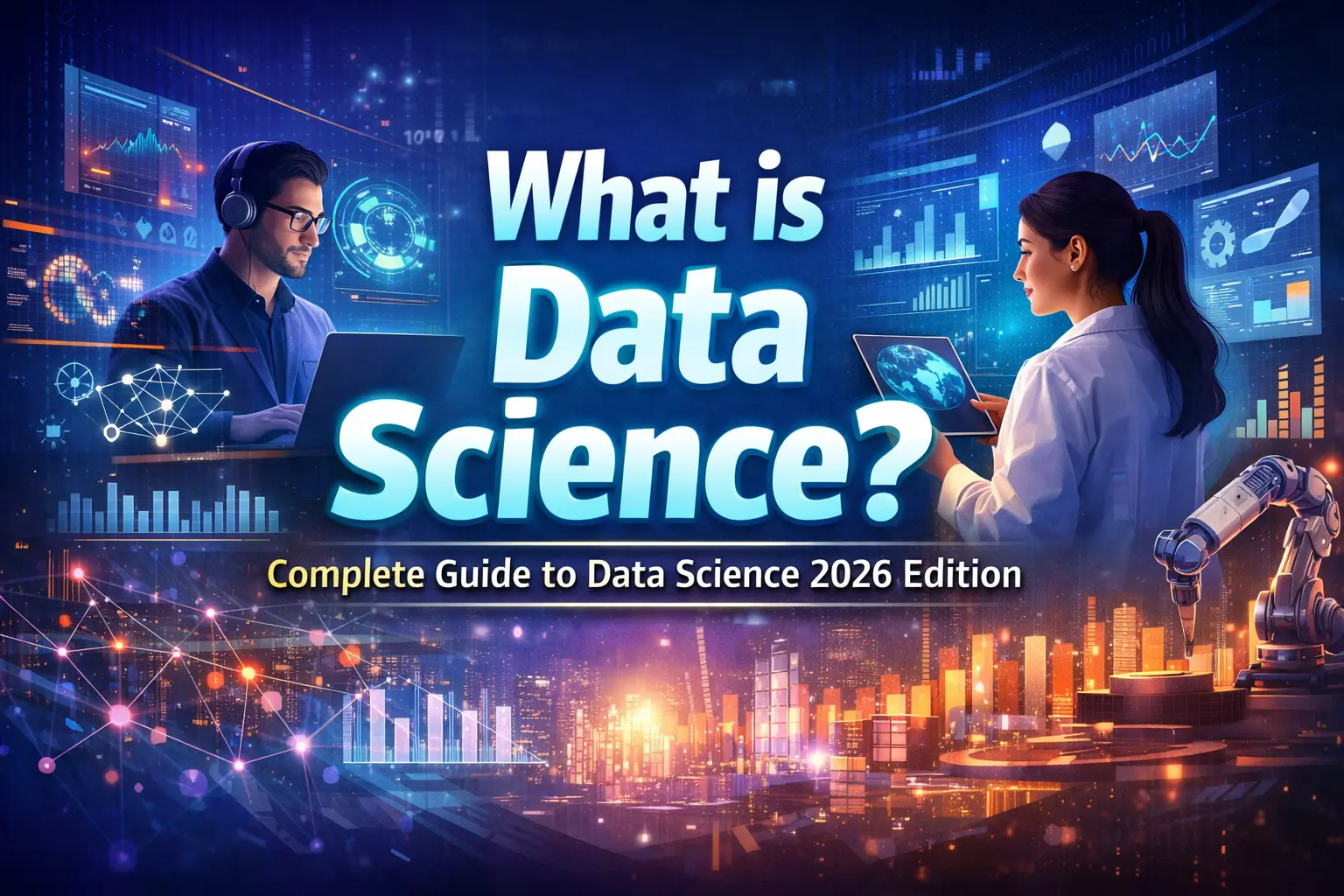
What is Data Science?
Data Science is the process of collecting, cleaning, analyzing, and interpreting structured and unstructured data to extract meaningful insights that help businesses make informed decisions.
In simple words, Data Science answers important business questions like:
- ● Why are customers leaving a product?
- ● Which marketing strategy brings more revenue?
- ● How can inventory waste be reduced?
- ● What will be the future sales trend?
It combines multiple disciplines:
- ● Programming
- ● Statistics
- ● Mathematics
- ● Machine Learning
- ● Business Intelligence
- ● Data Visualization
A Data Scientist does not just write code. They understand business problems and use data to provide solutions.
For example, an e-commerce company may have lakhs of customers. A Data Scientist can analyze their purchase patterns and predict what they are likely to buy next. This directly increases company revenue.
That is the power of Data Science.
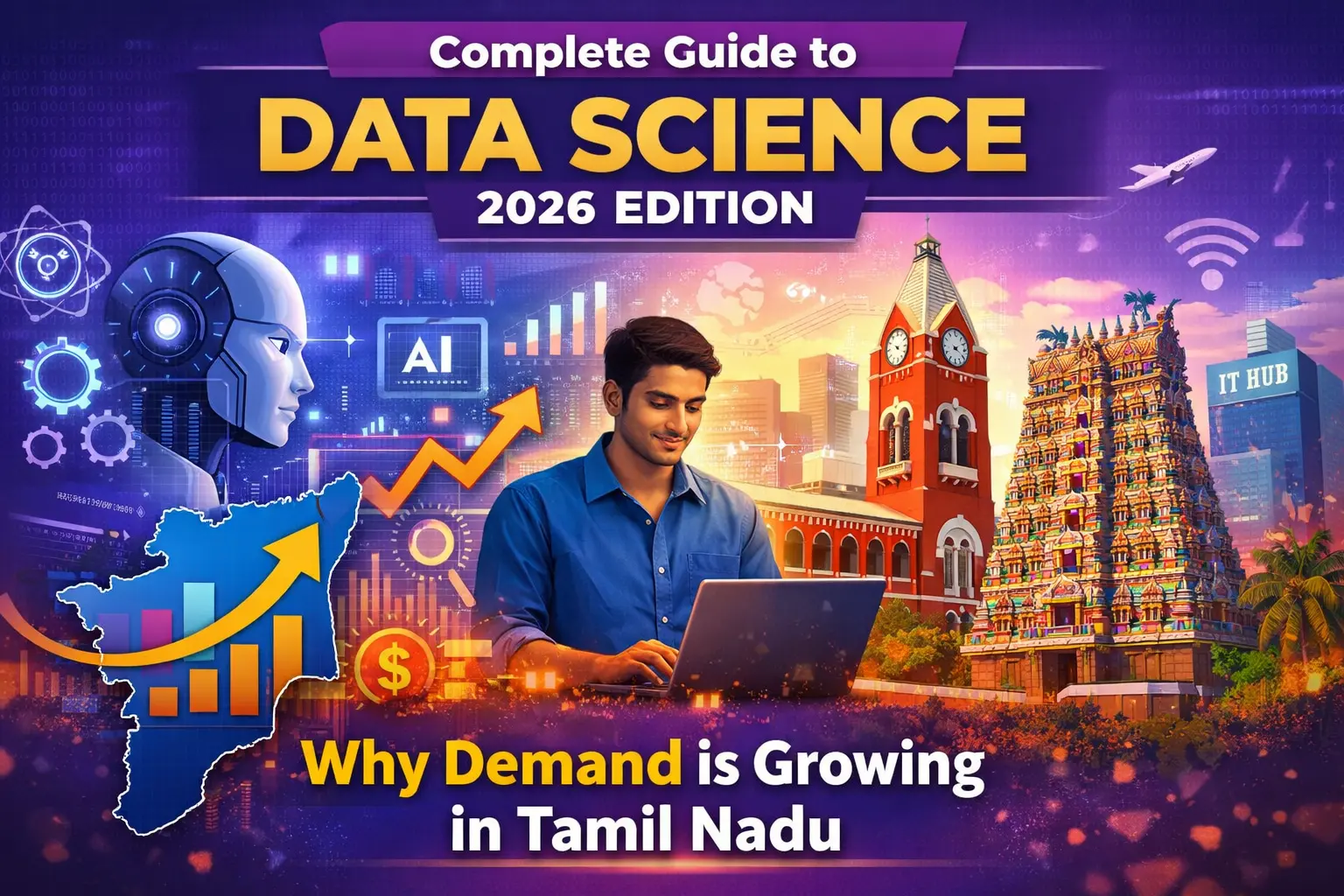
Why Demand is Growing in Tamil Nadu
Tamil Nadu is rapidly becoming one of India’s strongest digital economies. While Chennai remains a major IT hub, cities like Coimbatore are catching up quickly.
Here are some reasons why demand for Data Science professionals is growing in Coimbatore and across Tamil Nadu:
1. Expansion of IT Infrastructure
New IT parks and technology companies are expanding operations beyond metro cities to reduce costs and tap into skilled local talent.
2. Rise of Startups
Coimbatore has seen growth in SaaS startups, fintech companies, and e-commerce ventures. Startups rely heavily on data analytics to scale quickly.
3. Digital Transformation in Traditional Industries
Manufacturing, textile, healthcare, and logistics companies in Coimbatore are adopting digital tools. They now require professionals who can analyze production data, reduce operational costs, and forecast demand.
4. Remote Work Opportunities
After the remote work revolution, companies across India and even globally hire skilled Data Scientists from tier-2 cities. This has created global opportunities for students in Coimbatore.
5. Government Push for AI & Technology
India’s growing focus on Artificial Intelligence and digital innovation is increasing job demand in analytics and data science domains.
Because of these factors, students enrolling in a structured Data Science Course today have a strong advantage in the job market.
Salary Insights for Data Science Professionals in 2026
One of the main reasons students choose Data Science is salary potential. It is among the highest-paying IT careers in India.
However, salary depends on your:
- ● Skill level
- ● Project experience
- ● Tool expertise
- ● Communication skills
- ● Company type
Here is an approximate salary breakdown for 2026:
Freshers (0–1 Year Experience)
₹4 LPA – ₹7 LPA
Candidates with strong projects and internship experience may secure higher packages.
Mid-Level Professionals (2–5 Years Experience)
₹8 LPA – ₹15 LPA
Professionals working with Machine Learning, AI, or big data technologies often earn more.
Senior-Level Professionals (5+ Years Experience)
₹18 LPA – ₹30+ LPA
Leadership roles such as Senior Data Scientist, Analytics Manager, or AI Specialist command premium salaries.
In multinational companies and product-based firms, salaries can go even higher.
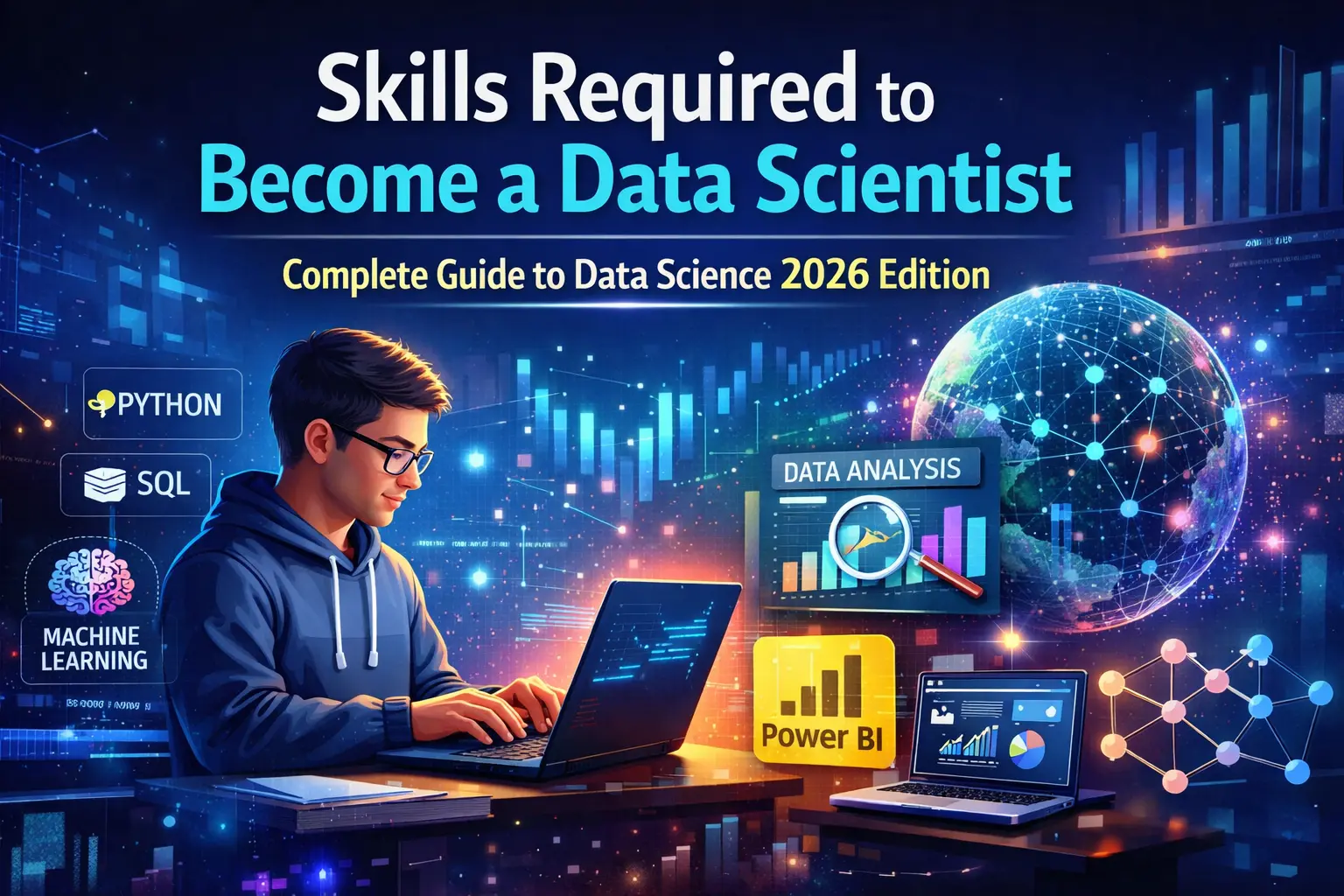
Skills Required to Become a Data Scientist
To succeed in Data Science, students must develop both technical and analytical skills.
1. Programming Skills
Python is the most widely used programming language in Data Science because of its simplicity and powerful libraries.
2. Statistics & Mathematics
You must understand:
- ● Mean, median, variance
- ● Probability
- ● Hypothesis testing
- ● Correlation
- ● Regression
Statistics forms the foundation of data analysis.
3. SQL and Database KnowledgeAlmost every company stores data in databases. You must know how to:
- ● Retrieve data
- ● Join tables
- ● Filter records
- ● Perform aggregations
It is not enough to analyze data. You must present it clearly. Visualization tools help communicate insights to non-technical stakeholders.
5. Machine LearningUnderstanding algorithms like:
- ● Linear Regression
- ● Logistic Regression
- ● Decision Trees
- ● Random Forest
- ● Clustering techniques
is crucial for predictive analytics.
6. Business UnderstandingData Science is not only technical. You must understand business problems and interpret results effectively.
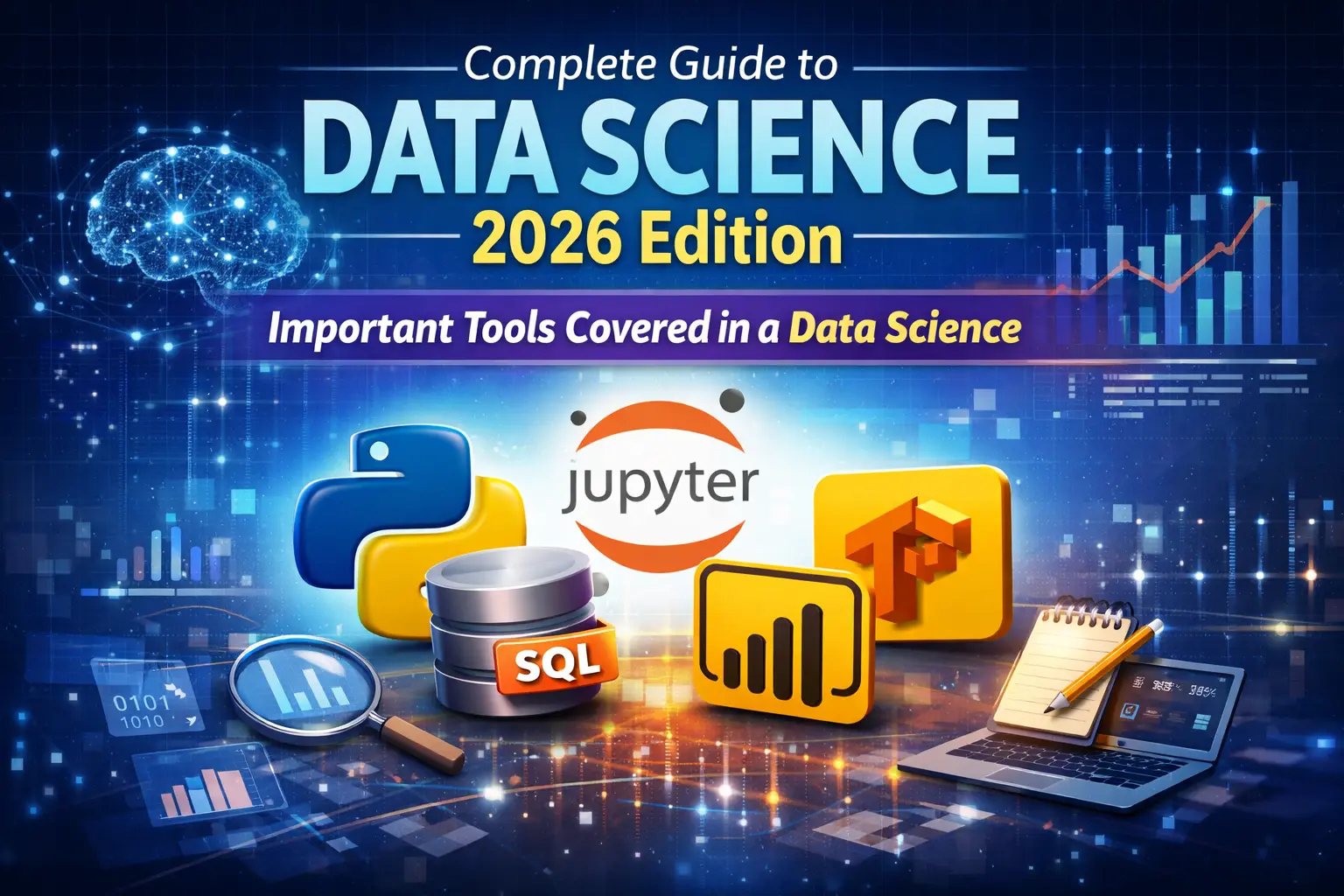
Important Tools Covered in a Data Science
A professional Data Science course should include hands-on training in the following tools:
PythonUsed for:
- ● Data cleaning
- ● Analysis
- ● Machine learning
- ● Automation
Popular libraries include Pandas, NumPy, Matplotlib, and Scikit-learn.
SQLEssential for:
- ● Managing large datasets
- ● Extracting information from databases
Used for:
- ● Building dashboards
- ● Creating interactive reports
- ● Visual storytelling
- ● Scikit-learn
- ● TensorFlow
- ● Keras
Detailed Syllabus
A job-focused syllabus built on live projects and real interview prep.
Module 1: Introduction to Data Science
Learn the role of a Data Scientist and the significance of data in today's world.
Module 2: Excel
Excel Basics:
Workbooks, Worksheets, Cells, and Ranges
Basic functions: SUM, AVERAGE, COUNT, MIN, MAX
Sorting, Filtering, and Formatting Data
Intermediate Excel:
Conditional Formatting, Data Validation
Lookup Functions: VLOOKUP, HLOOKUP, INDEX, MATCH
Working with Dates and Time functions
Basic Charts and Graphs (Bar, Line, Pie)
Module 3: Python
Python syntax: Variables, Data Types (int, float, string)
Data Structures and Methods
Control flow: if-else, for loops, while loops
Functions
Basic OOPS
Advanced OOPS
File and Error Handling
Modules, Packages and Libraries
Module 4: SQL
Introduction to relational databases and SQL
Basic SQL commands: SELECT, FROM, WHERE, ORDER BY
Filtering Data with AND, OR, NOT
Aggregation Functions: COUNT(), AVG(), SUM(), MIN(), MAX()
Joins: INNER, LEFT, RIGHT, FULL OUTER
Subqueries
GROUP BY and HAVING
Advanced Filtering: LIKE, IN, wildcards
Data Cleaning: NULL values and duplicates
Module 5: Tableau
Connecting to data sources (Excel, SQL)
Data Preparation and transformation
Visualization: Bar, Line, Scatter, Pie charts
Formatting visuals (titles, labels, colors)
Calculated fields and metrics
Table Calculations (running totals, percentages)
Interactive dashboards
Storytelling with data
Module 6: Power BI
Connecting to data sources
Power Query for data transformation
Visualization: charts and maps
Introduction to DAX
Data Modeling
Advanced DAX calculations
Dashboard creation
Publishing and sharing reports
Module 7: Statistics & Probability
Central Tendency, Variance, Standard Deviation
Probability and Distributions
Hypothesis Testing
Sampling Techniques
A/B Testing
Module 8: Machine Learning
Regression and Classification
Decision Trees and Random Forests
Clustering Techniques
PCA
Ensemble Methods (XGBoost)
Hyperparameter Tuning
Module 9: Deep Learning & NLP
Neural Networks
CNNs, RNNs, LSTMs
Training Techniques
NLP: Tokenization, Embeddings, Text Classification
Module 10: Capstone Project and Portfolio Development
Work on real-world datasets (sales, marketing, customer data)
Build dashboards and prediction models
Perform sentiment analysis and image classification
Develop recommendation systems
Upload projects to GitHub, LinkedIn, or personal website
Write clear documentation
Highlight tools and techniques used
Placement Support Details
When selecting a Data Science Course, placement assistance should be a major deciding factor.
Quality institutes provide:
- ● Resume preparation sessions
- ● LinkedIn profile optimization
- ● Mock technical interviews
- ● HR interview training
- ● Internship opportunities
- ● Real-time project guidance
- ● 100% placement assistance
Practical training combined with placement support significantly improves job success rates.
Students who work on live projects and complete internships often perform better in interviews because they can confidently explain their experience.
Frequently Asked Questions
1. Is Data Science a good career choice in 2026?
Yes. Data Science remains one of the fastest-growing IT fields with strong salary growth and long-term demand.
2. Can non-IT students join a Data Science course?
Yes. Students from mathematics, commerce, engineering, science, and even arts backgrounds can learn Data Science with structured training.
3. How long does it take to become job-ready?
Most structured courses take 4 months. Consistent practice and project work are essential.
4. Is coding mandatory?
Yes, basic to intermediate Python coding knowledge is required.
5. What is the minimum qualification required?
A degree in any discipline is generally sufficient. Logical thinking and analytical interest are more important.
6. Can I get a job in Coimbatore after completing the course?
Yes. With the growing IT ecosystem in Coimbatore and remote opportunities, job prospects are improving every year.
Conclusion
Data Science is not just another trending course. It is a long-term career path that combines technology, logic, and business intelligence.
With the rapid digital growth in Tamil Nadu and the increasing IT presence in Coimbatore, the demand for skilled data professionals is expected to rise significantly in 2026 and beyond.
Choosing the right Data Science Course that offers industry-relevant tools, practical projects, experienced trainers, and strong placement support can shape your entire career journey.
If you are serious about entering the IT industry with a high-paying and future-proof skill set, Data Science is one of the smartest choices you can make today.
Share this article
Ready to Start Your Tech Journey?
Join Code Purple Academy and transform your career with industry-leading courses